Buddy Punching and Time Theft: How to Spot and Stop Them
How proxy attendance and time theft happen, the data patterns that reveal them, what they cost a 60-worker factory, and controls that work.
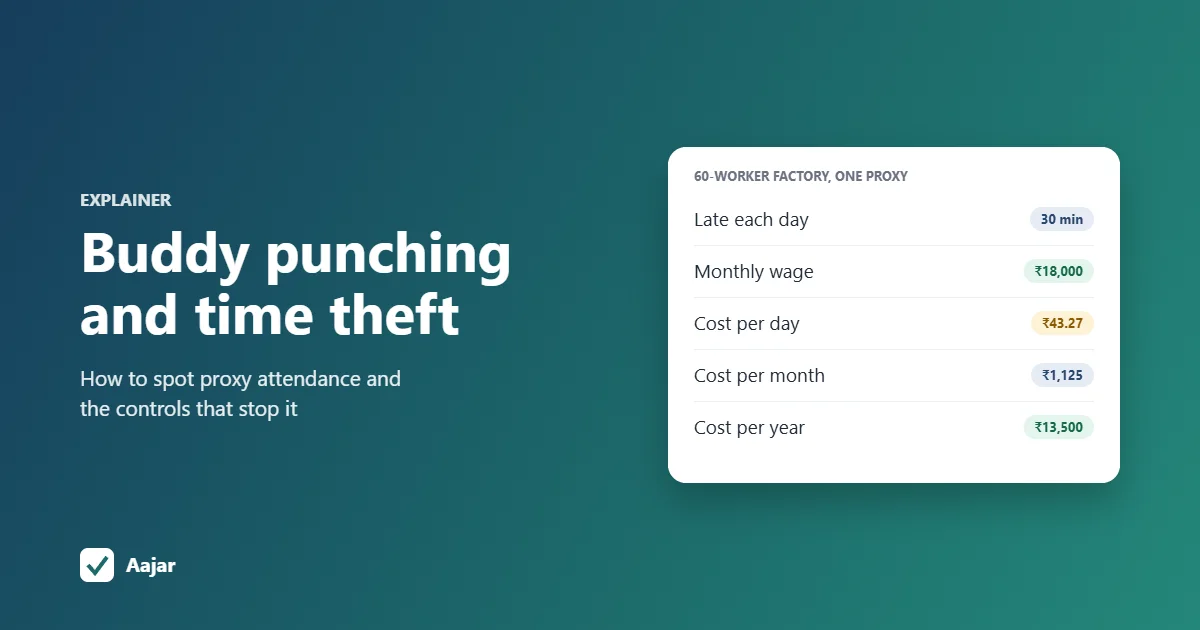
Short answer: buddy punching is when one employee marks attendance for another who is late, absent or has left early, by signing the register, punching their card or using their app login; it is one form of time theft, which is any paid time an employee claims but doesn't work. If one worker in a 60-worker factory arrives 30 minutes late daily while a friend punches in, that costs about ₹1,125 a month in wages. Controls that tie the punch to the person and the place (biometrics, face or selfie check-in, a geofence) prevent most of it.
This guide explains how proxy attendance happens in Indian workplaces, the patterns in your data that give it away, what it costs with worked numbers, and the controls that work without watching people all day.
What does buddy punching mean?
Buddy punching means one person records attendance on behalf of a colleague. The colleague gets paid for time they were not at work, and the employer usually doesn't find out because the record looks normal.
In India it is often called proxy attendance. It is rarely planned as fraud; it usually starts as a favour between friends ("my bus is late, sign for me") and becomes a habit when nobody checks.
What counts as time theft?
Time theft is any time an employee is paid for but doesn't work, through a false or bent attendance record. Buddy punching is one form. The common ones in Indian workplaces are below.
| Form of time theft | How it usually happens | Where it is common |
|---|---|---|
| Signing the register for a friend | A colleague writes the absent person's time and signature in the muster roll | Shops, small offices, sites with a paper register |
| Punching someone else's card | One worker swipes or punches two RFID or punch cards at the gate | Factories and warehouses with card machines |
| Sharing app logins | An employee gives their phone or password to a colleague who checks in for them | Offices and teams using a mobile attendance app |
| Fake GPS apps | A location-spoofing app makes the phone appear to be at the office or site | Field sales, service and delivery staff |
| Long breaks | Tea or lunch breaks that stretch well past the allowed time, with the day's punches still showing a full shift | Any workplace with no break rule |
| Leaving early | Walking out before shift end while a friend punches out at the normal time | Shift-based factories, security agencies, retail |
How do you spot buddy punching in attendance data?
You rarely catch proxy attendance by watching the gate. You catch it by looking for patterns that real arrivals don't produce. Run these checks on a month of attendance once a quarter, or whenever a supervisor raises a doubt.
- Punches seconds apart. Two or three people who always punch within the same minute, in the same order, every day. Real arrivals are spread out.
- Perfect attendance, poor output. Someone whose register is never late but whose supervisor says they are "never there in the morning".
- The same time every day. A check-in at exactly 9:00 or a check-out at exactly 6:00 on every day of the month, especially in a paper register.
- Same handwriting or same device. Several names in the register in one hand, or several employees checking in from the same phone.
- Location that doesn't move. A field employee whose phone shows the same exact point all day, or who appears at a site with no travel time from the previous one. Both can point to a fake GPS app.
- Headcount doesn't match. The 10 a.m. "who is in today" list says 58 present, but a quick walk through the shop floor counts 55.
A pattern is a reason to look closer, not proof. Talk to the employee and the supervisor before you conclude anything.
What does time theft cost a small business?
Here is a worked example for a 60-worker factory. The assumptions are stated so you can swap in your own numbers.
| Assumption | Value |
|---|---|
| Monthly gross wage of the worker | ₹18,000 |
| Working days in the month | 26 (six-day week) |
| Shift length | 8 hours |
| Time missed each day | 30 minutes (arrives late, a friend punches in on time) |
| Step | Working | Result |
|---|---|---|
| Daily wage | ₹18,000 ÷ 26 | ₹692.31 |
| Hourly wage | ₹692.31 ÷ 8 | ₹86.54 |
| Cost of 30 minutes | ₹86.54 × 0.5 | ₹43.27 |
| Cost per month, one worker | ₹43.27 × 26 | ₹1,125 |
| Cost per year, one worker | ₹1,125 × 12 | ₹13,500 |
| If 5 of the 60 workers do it | ₹1,125 × 5 | ₹5,625 a month (₹67,500 a year) |
A full-day proxy is more expensive: a friend marking an absent worker present twice a month costs ₹692.31 × 2 = about ₹1,385 for that worker alone. These figures are wages only. They leave out the knock-on costs, such as a line that starts late, overtime paid to cover the gap, and honest workers who stop being on time when they see others get away with it.
How to stop buddy punching without micromanaging
The aim is to make a false punch hard and a true punch easy, so you don't need a supervisor at the gate. Pick the control that fits how and where people mark attendance.
| Control | What it stops | Best for | Limits |
|---|---|---|---|
| Biometric machine (fingerprint or face) | Card punching and register signing for others | Factory gates, warehouses, one main entrance | Hardware cost; fingerprints fail on worn or dusty fingers; doesn't cover field staff |
| Face check-in on the phone | Shared logins; the selfie must match the enrolled face | Offices and sites without a machine | Needs a phone with a camera; enrol faces carefully |
| Selfie check-in | Discourages shared logins; HR can review photos | Small teams where a quick photo check is enough | Photos are reviewed, not matched, so someone has to look |
| Geofence | Checking in from home or the bus | Offices, shops, sites and field staff | On its own, doesn't stop a friend at the site checking in on your phone |
| Rotating QR code at the entrance | Checking in from a photo of the code sent on WhatsApp | Offices and sites with a screen at the door | A friend can still scan with your phone, so pair it with face or selfie |
| Spot checks | Everything, as a deterrent | Any workplace | Takes a few minutes of a supervisor's time |
Most workplaces need two layers, not five. A factory with one gate can rely on a biometric machine; our guide to biometric attendance machine types and prices covers the choices. For sales and service teams, a geofence plus a face or selfie check is usually enough; see GPS and geofence attendance for field staff for how to set the radius and handle staff who move between sites.
Why spot checks still matter
A two-minute headcount once or twice a week, at a random time, is one of the cheapest controls there is. Compare the number of people on the floor with the live present list. If they match week after week, you can stop worrying; if they don't, you know where to look.
What about fake GPS apps?
Location-spoofing apps can fool a check that relies only on the phone's reported location. Adding a selfie or face match means the person still has to be in the photo, and a plain office wall in 20 photos in a row from a "site visit" stands out on review. Treat a location that never moves, or jumps between far-off places in minutes, as a reason to ask.
Write a clear policy and apply it the same way to everyone
Technology works best when people know the rules. A short attendance policy should say:
- Each person marks only their own attendance, by the approved method.
- Marking attendance for someone else, sharing a login or using a location-spoofing app is misconduct, for both people involved.
- The break times allowed, and that breaks beyond them count as late or short hours.
- How to report a missed or wrong punch, so no one feels they need a friend to cover.
- What data you collect (photo, face, location) and why, and that location is recorded only at check-in and check-out, not all day.
- The consequences, applied as per your standing orders or conduct rules: usually a warning first, then pay for the missed time, then disciplinary action for repeat cases.
The last point matters most. A rule that is enforced for some and ignored for others teaches people that proxy attendance is safe. A simple way to report a late arrival also removes much of the reason to ask a friend to cover.
Preventing buddy punching on Aajar
Every Aajar plan, from Starter at ₹20 per user per month, includes a live "who is in today" view and late grace and half-day rules, so spot checks and late marks need no extra work. Geofenced check-in is on Growth (₹35 per user per month), and on Growth and Business you can switch on Selfie, Face or QR check-in at ₹5 per user per month each; the QR can change every 30 seconds, so a photo of it is useless. Biometric device sync with eSSL and similar machines is on Business (₹50 per user per month).
Long breaks still need a supervisor's eye and a clear break rule. Every plan is free for the first 3 months for organisations with up to 50 users; see Aajar pricing.
Frequently asked questions
What does buddy punching mean?
It means one employee marks attendance for another, by signing the register, punching their card or using their login, so the absent or late person is recorded as present.
What are the consequences of buddy punching?
For the employer, it means paying for time nobody worked and lower trust on the floor. For employees, it is usually treated as misconduct for both the person who was covered and the one who covered, with action taken as per the company's standing orders or conduct rules.
Is time theft the same as buddy punching?
No. Time theft is the wider term for any paid time not worked, including long breaks, leaving early and fake GPS check-ins. Buddy punching is one form of it.
Can a biometric machine stop all proxy attendance?
It stops one person punching for another at the machine, but not someone who punches in and then leaves, or staff who work away from the gate. Pair it with spot checks and, for field staff, a geofenced phone check-in.
How do I stop proxy attendance without upsetting honest employees?
Use a quick check-in that is the same for everyone, explain why you are introducing it, and give people an easy way to report a genuine late arrival or missed punch. Most honest employees welcome a system that stops colleagues getting paid for time they don't work.
Keep reading
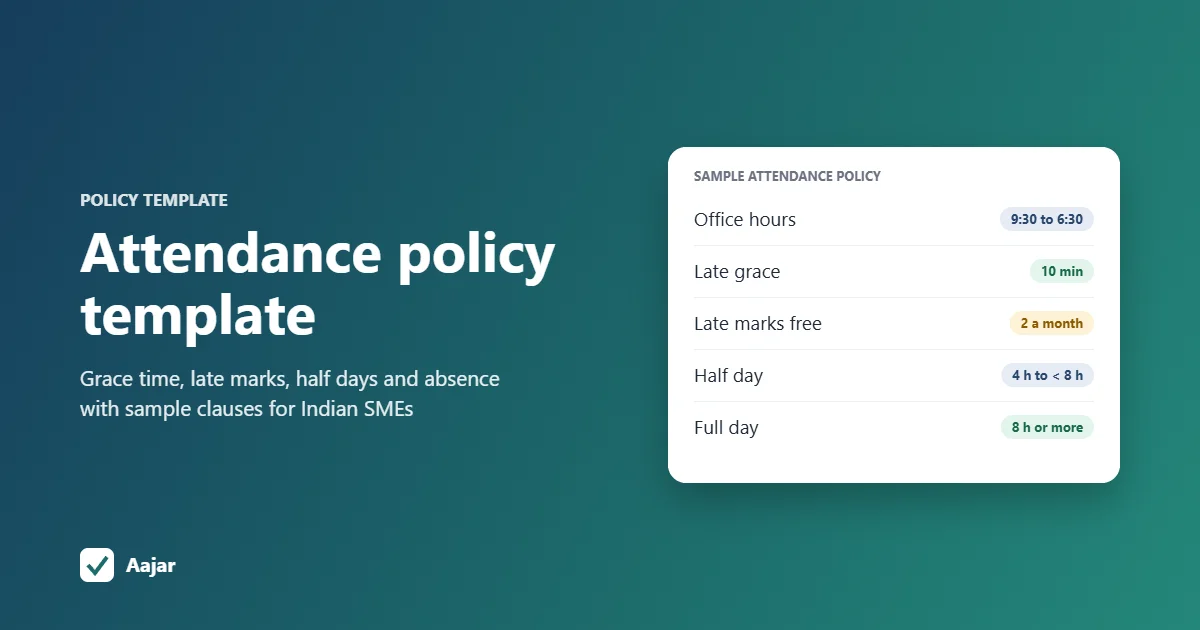
Attendance Policy Template with Late Coming Rules
A ready attendance policy template for Indian SMEs, with sample clauses for working hours, grace time, late marks, half days and absence.

On Duty (OD): Meaning, Policy and How to Track It
What OD means in attendance, how it differs from leave and WFH, how to approve it, a sample policy and tour diary, and why OD days are paid.

Timesheet Template and When to Use Timesheets Instead of Attendance
A free weekly and daily timesheet template, Excel formulas for hours and breaks, and how timesheets differ from attendance.