Attendance Policy Template with Late Coming Rules
A ready attendance policy template for Indian SMEs, with sample clauses for working hours, grace time, late marks, half days and absence.
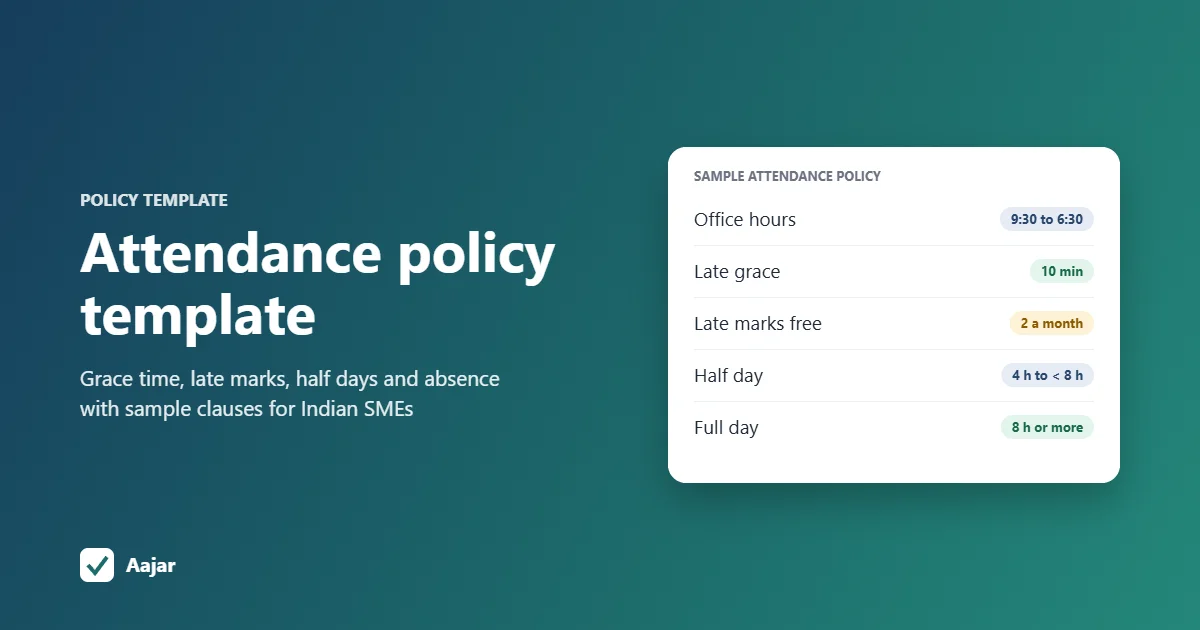
Short answer: an attendance policy is a written set of rules that tells employees their working hours, how to record attendance, how much grace time they get, what counts as a late mark, half day or absence, and what happens if the rules are broken. A simple SME policy might allow 10 to 15 minutes' grace, count later arrivals as late marks and treat under 4 hours as absent. Keep normal hours within the legal limit of 8 a day and 48 a week, and keep salary deductions for late coming in proportion to the time actually lost.
Below is a ready attendance policy template you can copy and edit, with sample clause text for each section, a late coming policy comparison, a worked deduction example and the steps to roll it out.
What is an attendance policy?
An attendance policy is the document that sets out when employees must be at work and how their presence is recorded and paid. It turns everyday questions ("I was 12 minutes late, is that a half day?") into rules everyone has read in advance.
It is separate from the leave policy. The attendance policy covers hours, punches, late marks, half days and absence; the leave policy template for Indian SMEs covers leave types, balances, carry-forward and encashment. Most companies keep the two side by side in the employee handbook.
Why does a small business need one?
- Fewer arguments at month end: payable days are calculated from rules, not from memory or favours.
- Consistent treatment: the same 20 minutes late means the same thing for every employee and every branch.
- Cleaner records: your attendance register-cum-muster roll and payroll match, which matters if an inspector asks for them.
What should an attendance policy include?
These are the sections in the template below. Leave out any that don't apply, for example field work in a single-site shop.
| Section | What it decides |
|---|---|
| 1. Purpose | Why the policy exists |
| 2. Scope | Who it covers: staff, trainees, contract workers |
| 3. Working hours and weekly off | Start and end time, breaks, weekly off days |
| 4. Recording attendance | Biometric, phone check-in or register; who may mark it |
| 5. Grace period | How many minutes late is still on time |
| 6. Late marks | What counts as late and what follows |
| 7. Half day | Hours that make a half day or full day |
| 8. Absence | Unauthorised absence, informing the manager, loss of pay |
| 9. Missed punches | How a forgotten check-in or check-out is corrected |
| 10. Early leaving | Permission to leave early, short absences |
| 11. Overtime | Approval, consent and pay |
| 12. Field work and on-duty | Client visits, travel, work at another site |
| 13. Consequences | Steps for repeated lateness or absence |
| 14. Review | Who owns the policy and how often it is updated |
Attendance policy template for Indian SMEs
Replace the text in [square brackets] with your own details. The sample values suit an office or shop working 9:30 a.m. to 6:30 p.m., six days a week; a factory with shifts would add its shift timings in section 3.
1. Purpose
"This policy sets out the working hours of [Company Name] and the rules for recording attendance, late arrival, half days and absence. It helps us pay everyone correctly and treat everyone the same way."
2. Scope
"This policy applies to all employees, trainees and interns of [Company Name] at all locations. Contract workers follow the timings of the site they work at; their attendance is shared with their contractor each month."
3. Working hours and weekly off
"Office hours are [9:30 a.m. to 6:30 p.m.], Monday to Saturday, with a [1-hour] lunch break, giving 8 working hours a day. The weekly off is Sunday [and the second and fourth Saturdays]."
"Shift timings, where applicable, are published by the manager at least [one week] in advance."
Under the OSH Code, normal working hours are up to 8 a day and 48 a week; work beyond that is overtime (PIB factsheet on the OSH Code, Nov 2025). Intervals for rest and spread-over are set by the appropriate government, so check your state's rules before fixing break timings.
4. Recording attendance
"Every employee must check in on arrival and check out when leaving, using [the biometric machine at the entrance / the attendance app on their phone]. Marking attendance for another person is not allowed and will be treated as misconduct. The earliest punch of the day is taken as check-in and the last punch as check-out."
Records kept this way form your attendance register-cum-muster roll. The Ministry of Labour's compliance handbook says registers can be physical or electronic and must be preserved for 5 years (MoLE Compliance Handbook for Employers, p. 9). Our guide to the muster roll format and digital records shows what the register should contain.
5. Grace period
"Employees checking in up to [10] minutes after the start time are treated as on time. The grace period does not change the end of the working day."
6. Late marks
"Check-in after the grace period, and up to [2 hours] after the start time, is a late mark. [Up to 2] late marks in a month are allowed without any action."
"From the [3rd] late mark, [each further late mark / every 3 late marks] will be adjusted against [half a day of casual leave, and if no leave is available, half a day of loss of pay]. Check-in more than [2 hours] late is treated as a half day."
7. Half day and full day
"A day with [8] or more hours between check-in and check-out is a full day. [4] hours to less than [8] hours is a half day. Less than [4] hours is treated as absent, unless approved by the manager."
8. Absence
"An employee who cannot come to work must inform their manager by [10:00 a.m.] the same day and apply for leave as per the leave policy. Absence without approved leave is unpaid. Absence without information for [3] consecutive working days will be treated as unauthorised absence and may lead to disciplinary action."
9. Missed punches
"If an employee forgets to check in or check out, they must inform [HR / their manager] within [2] working days with the actual times. The correction is made only after the manager confirms it. More than [3] missed punches in a month may be treated as late marks."
10. Early leaving and short permission
"Leaving before the end of the working day needs the manager's approval in advance. Employees may take short permission of up to [2 hours, twice] a month for personal work without a deduction. Early leaving without approval is treated like a late mark, or as a half day if the hours fall below the full-day limit."
11. Overtime
"Overtime is work beyond [8] hours in a day or [48] hours in a week. It must be approved by the manager in advance and needs the employee's consent. Overtime is paid at twice the ordinary rate of wages [or as per the applicable law]."
The consent and twice-the-rate rule come from the OSH Code (PIB factsheet). For the calculation, see how to calculate overtime pay in India.
12. Field work and on-duty
"Employees working away from the office, at a client site, on travel or at another branch, must apply for on-duty in advance or on the same day. Approved on-duty days count as full working days. Field staff [check in from their phone at the first visit of the day]."
13. Consequences of repeated lateness or absence
- "First time the monthly limit is crossed: a reminder from the manager.
- Repeated in the next month: a written warning.
- Continued after a written warning: action under the company's standing orders or disciplinary procedure, after giving the employee a chance to explain."
14. Review
"This policy is owned by [HR / the Managing Director] and is reviewed every [12 months] or when the law changes. Employees will be informed of changes in writing at least [15 days] before they apply."
Late coming policy: which late mark rule should you choose?
Section 6 is where policies differ most. Here are the four common approaches to a late mark policy, with their trade-offs.
| Approach | How it works | Good for | Watch out for |
|---|---|---|---|
| Grace period only | Late beyond grace is recorded, managers follow up | Small offices with flexible roles | No clear consequence, so habits don't change |
| Late marks against leave | Every 3 late marks = half a day of casual leave | SMEs that want no salary cut while leave remains | Explain it before the first month, or employees feel cheated |
| Late marks to loss of pay | Every 3 late marks = half a day unpaid | Shops and factories where start time is fixed | Deduction may exceed the time lost (see example below) |
| Proportional deduction | Pay is cut only for the minutes actually missed | Shift work where time is tracked to the minute | Needs accurate punch data and more calculation |
Can you deduct salary for late coming?
The Code on Wages, 2019 allows deductions only for the purposes it lists, and caps total deductions in a wage period at 50% of wages (section 18). Deductions for absence from duty are permitted, including absence for part of the required working period, but they cannot be a larger share of the wages than the absence is of the working period (section 20) (India Code: Code on Wages, 2019).
The Code does not mention late marks directly. Whether a rule like "3 late marks = half day unpaid" is proportionate when the minutes actually lost are fewer is not settled, so the safer course is to adjust late marks against leave first, or to deduct only for time missed.
A fixed rupee "late fine" is a fine, which under section 19 is allowed only for acts listed in a notice approved in advance, after a chance to explain, and within 3% of the wages for that period. Many SMEs avoid fines for this reason.
Worked example: late marks for a ₹18,000 salary
A 25-person retail chain in Nagpur pays a store assistant ₹18,000 a month for 26 working days of 8 hours. In October she checks in 20 minutes late on 4 days, beyond the 10-minute grace period, and has no casual leave left.
| Rule | Working | Deduction |
|---|---|---|
| 3 late marks = half day unpaid | ₹18,000 ÷ 26 days = ₹692.31 a day; half day = ₹346.15 | ₹346 |
| Proportional (time actually lost) | ₹18,000 ÷ (26 × 8) = ₹86.54 an hour; 4 × 20 = 80 minutes; ₹86.54 × 80 ÷ 60 = ₹115.38 | ₹115 |
The half-day rule cuts about three times the wages for the time she missed. If your policy uses it, adjust against leave first, write the rule down, share it before it applies and use the same divisor (26 days, 30 days or calendar days) every month.
How to write an attendance policy
- Write down what you do today. Note your actual timings, weekly offs and how late arrival is handled now; most SMEs already have unwritten rules.
- Decide the numbers. Grace minutes, late marks allowed, half-day and full-day hours, and the missed-punch deadline. Use the template values above as a starting point.
- Check the legal limits. Normal hours, overtime pay and deductions should follow the labour codes and your state's rules. If you have standing orders, keep the policy consistent with them.
- Match it to your leave policy and payroll. The late-mark rule must say whether it uses leave or loss of pay, and payroll must use the same day divisor.
- Set it up in your attendance system. If the machine or app calculates late marks with a different grace time from the policy, employees will dispute every payslip.
- Share it and get acknowledgement. Email it or put it in the handbook, explain it in a short meeting, and keep each employee's acknowledgement on file.
- Review after the first two months. Look at late and absence reports; if half the team is late every day, the start time may be the problem, not the people.
The daily work of applying these rules, checking punches and closing attendance for payroll, is covered in our guide to running a time office without paper.
Running your attendance policy on Aajar
On Aajar's Starter plan (₹20 per user per month) you set the late grace time, half-day and full-day rules, weekly offs and alternate-Saturday rules once, and they are applied to every check-in from phone or computer. Clock-in reminder notifications nudge employees to check in, and permission (short absence) requests, leave and payroll with payslips are on the same plan, so late marks, half days and leave flow into salary.
Overtime and on-duty requests with approvals, along with shifts and geofenced check-in for field staff, are on Growth (₹35 per user per month). If your policy converts a number of late marks into a half day, check during the free trial how to apply that rule in payroll. Every plan is free for 3 months for organisations with up to 50 users; see Aajar pricing.
Frequently asked questions
What is an attendance policy?
It is a written set of company rules covering working hours, how attendance is recorded, grace time, late marks, half days, absence and overtime. It tells employees what is expected and tells payroll how to count payable days.
How to write an attendance policy?
Start from your current practice, fix the numbers (grace minutes, late marks allowed, half-day hours), check them against the labour codes and your leave policy, set them up in your attendance system, and share the policy with every employee in writing.
What is a good grace period for late coming?
A grace of 10 to 15 minutes is a reasonable range. Shorter grace suits shift work where a handover depends on the next person arriving; longer grace suits offices where traffic is unpredictable.
Is "3 late marks = half day" legal?
It is a common company rule, but the Code on Wages limits deductions for absence to a proportion of the time actually missed, and the law does not address late marks directly. Adjusting late marks against leave first, or deducting only for time lost, is the lower-risk choice.
Do I need to keep attendance records?
Yes. An attendance register-cum-muster roll is one of the registers listed in the Ministry of Labour's compliance handbook, and it can be kept electronically but must be preserved for 5 years.
This article is general information, not legal advice.
Keep reading
Buddy Punching and Time Theft: How to Spot and Stop Them
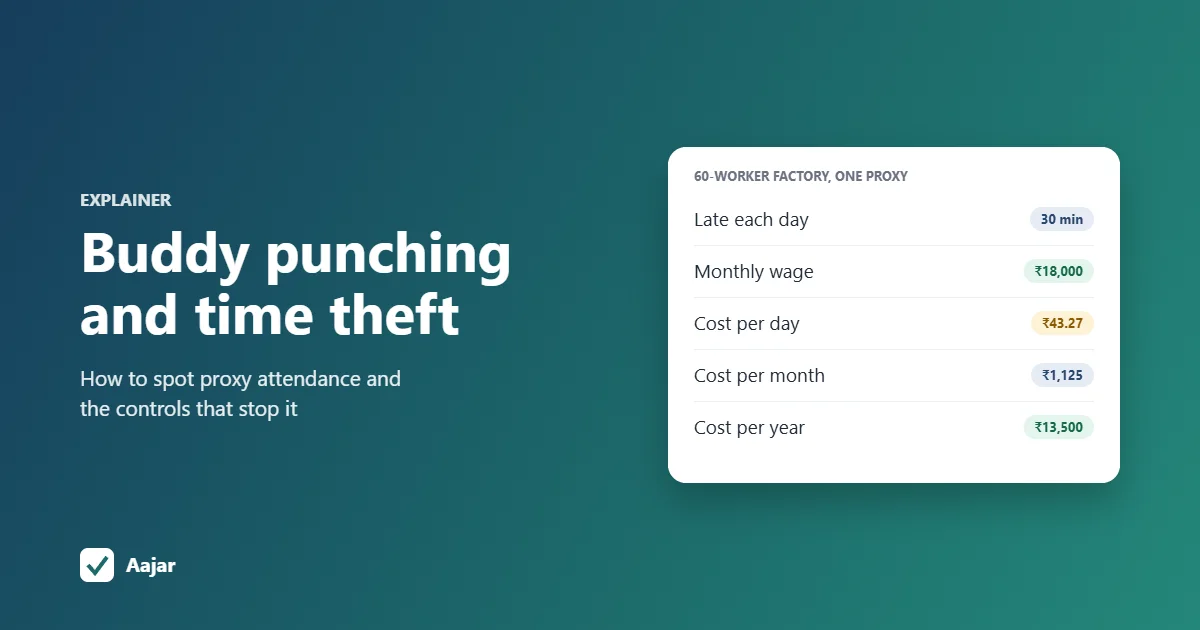
How proxy attendance and time theft happen, the data patterns that reveal them, what they cost a 60-worker factory, and controls that work.

On Duty (OD): Meaning, Policy and How to Track It
What OD means in attendance, how it differs from leave and WFH, how to approve it, a sample policy and tour diary, and why OD days are paid.

Timesheet Template and When to Use Timesheets Instead of Attendance
A free weekly and daily timesheet template, Excel formulas for hours and breaks, and how timesheets differ from attendance.