PF Calculation: EPF, EPS and Employer Share (2026)
How to work out PF under the labour codes: the 12% split into EPF and EPS, the new ₹25,000 ceiling, EDLI, admin charges and the 50% wages rule.
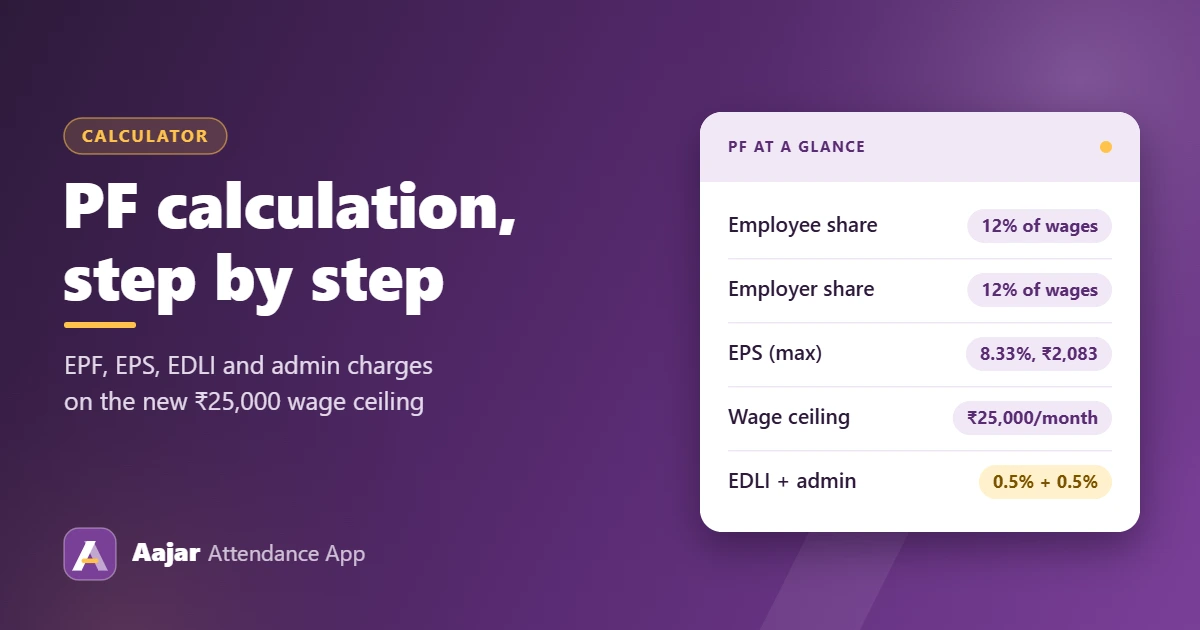
Short answer: For PF calculation, take the employee's "wages" (basic pay, dearness allowance and retaining allowance, plus any allowances above 50% of total pay). The employee pays 12% of that, and the employer also pays 12%, of which 8.33% goes to the pension scheme (EPS) and the rest to EPF. Since 17 September 2026 the wage ceiling is ₹25,000 a month, so the EPS share is at most ₹2,083 and a capped employee share is at most ₹3,000.
On top of the 12%, the employer pays 0.5% for EDLI insurance and 0.5% as administrative charges. This guide shows how each piece is worked out, how the new ceiling changed the numbers, and how the labour codes changed what counts as wages. It ends with a worked example for three employees.
What changed in PF calculation in 2025–26?
Three changes matter for payroll. First, the Code on Social Security, 2020 came into force on 21 November 2025, so PF is now worked out on the Code's definition of "wages". Second, new EPF, EPS and EDLI Schemes under the Code replaced the 1952 and 1976 schemes from 29 June 2026, and the contribution rates were notified again in July 2026.
Third, the wage ceiling went up from ₹15,000 to ₹25,000 a month from Thursday, 17 September 2026. The Union Cabinet approved it on 16 September 2026, as the PIB release on the higher EPFO wage ceiling explains. This was the first change to the ceiling since September 2014.
The percentages themselves did not change. What changed is the wage base they apply to, and who must be covered.
What are the current PF contribution rates?
For most establishments the rates are as below. A few notified industries (such as jute, beedi, brick, coir outside spinning and guar gum) and establishments under an approved insolvency plan pay at 10% instead of 12%.
| Component | Rate | Paid by | Maximum at ₹25,000 ceiling |
|---|---|---|---|
| Employee PF (EPF) | 12% of wages | Employee, deducted from salary | ₹3,000 (if capped) |
| Employer share to EPS | 8.33% of wages up to ceiling | Employer | ₹2,083 |
| Employer share to EPF | 12% minus EPS share (3.67% on capped wages) | Employer | ₹917 (if capped) |
| EDLI | 0.5% of wages up to ceiling | Employer | ₹125 |
| Administrative charges | 0.5% of PF wages | Employer | ₹125 (if capped); minimum ₹500 a month per establishment |
The legal basis is section 16 of the Code on Social Security, 2020. It sets 10% as the base rate, lets the Central Government notify 12% for establishments, and caps the pension share at 8.33% of wages. EPFO also lists the present rates of contribution on its site.
What counts as "wages" for PF under the Code on Social Security?
Under section 2(88) of the Code, wages include basic pay, dearness allowance and retaining allowance. Items such as HRA, conveyance, overtime, commission, bonus and gratuity are listed as exclusions. But there is a catch: if the excluded items together are more than half of total remuneration, the extra amount is added back to wages.
The Ministry of Labour's FAQs on the labour codes give a simple version. If allowances and benefits (other than gratuity and retrenchment compensation) exceed 50% of total remuneration, the excess is added to wages. The same definition applies across all four labour codes.
In practice, many payroll teams now run this check every month:
- Add up total monthly remuneration (gross pay).
- Add up everything other than basic, DA and retaining allowance.
- If that second figure is above 50% of gross, add the excess to basic plus DA.
- The result is the "wages" figure for PF, subject to the ceiling.
The Ministry's additional FAQs add that overtime counts in this test and annual performance incentives do not. Overtime pay itself is covered in our guide on how to calculate overtime pay.
How do you do PF calculation step by step?
Once you have the wages figure, the monthly PF calculation follows a fixed order.
- Find PF wages: wages as defined above, for the days actually paid in the month.
- Apply the ceiling if you choose to: employers may restrict contributions to ₹25,000 even when wages are higher.
- Employee share: 12% of PF wages.
- Employer total: 12% of PF wages.
- EPS share: 8.33% of wages up to ₹25,000.
- Employer EPF share: employer total minus EPS share.
- EDLI and admin charges: 0.5% each, as in the table above.
A common approach is to round each share to the nearest rupee and take the employer EPF share as the balance. That is why the EPS maximum shows as ₹2,083 (8.33% of ₹25,000 is ₹2,082.50).
How is the employer contribution to PF split?
The employer contribution to PF is 12% of wages, but it does not all go to the employee's PF account. Up to 8.33% of wages (on wages up to ₹25,000) goes to the pension fund. The balance goes to the employee's EPF account and earns interest.
EDLI and admin charges are paid on top of the 12%. They are not deducted from the employee's salary.
How is EPS calculated?
EPS calculation is 8.33% of wages, limited to wages of ₹25,000 a month. So an employee with wages of ₹20,000 gets ₹1,666 into EPS, and anyone at or above ₹25,000 gets ₹2,083. Before 17 September 2026 the cap was ₹1,250 (8.33% of ₹15,000).
Not every member gets an EPS share. EPFO's FAQs on the revised ceiling say EPS membership is for employees whose wages at joining (or on the date the new ceiling took effect) were not above the ceiling. For a member outside EPS, the full employer 12% goes to EPF.
Is PF mandatory for salary above ₹25,000?
Employees whose wages are up to ₹25,000 must be covered from the date they join, or from 17 September 2026 if they were already working and had been left out earlier. Above the ceiling, coverage for a new joiner is optional and needs the employer's consent.
For existing members with higher wages, contributions can be restricted to the ceiling. Some employers instead contribute on full wages; that is a policy choice, and it should be written into the offer letter and payroll rules.
Worked example: PF calculation for a Coimbatore distribution company
Take a 40-person distribution company in Coimbatore. It restricts PF to the ₹25,000 ceiling. Here are three employees for October 2026, each with full paid days.
- Murugan, warehouse helper: gross ₹16,000 (basic plus DA ₹12,000, HRA ₹4,000).
- Priya, accounts executive: gross ₹34,000 (basic ₹14,000, HRA ₹12,000, conveyance ₹8,000).
- Karthik, sales manager: gross ₹70,000 (basic ₹35,000, other allowances ₹35,000). He has been an EPS member for years.
Step 1: Work out wages under the 50% rule
Murugan's allowances are ₹4,000, well under half of ₹16,000, so his wages stay at ₹12,000. Karthik's allowances are exactly half of his gross, so his wages are ₹35,000.
Priya's allowances are ₹12,000 + ₹8,000 = ₹20,000. Half her gross is ₹17,000, so the excess is ₹20,000 − ₹17,000 = ₹3,000. Her PF wages become ₹14,000 + ₹3,000 = ₹17,000.
Step 2: Apply the rates
| Item | Murugan | Priya | Karthik |
|---|---|---|---|
| PF wages used | ₹12,000 | ₹17,000 | ₹25,000 (capped) |
| Employee PF (12%) | ₹1,440 | ₹2,040 | ₹3,000 |
| Employer total (12%) | ₹1,440 | ₹2,040 | ₹3,000 |
| Of which EPS (8.33%) | ₹1,000 | ₹1,416 | ₹2,083 |
| Of which EPF (balance) | ₹440 | ₹624 | ₹917 |
| EDLI (0.5%) | ₹60 | ₹85 | ₹125 |
| Admin charges (0.5%) | ₹60 | ₹85 | ₹125 |
| Total employer cost | ₹1,560 | ₹2,210 | ₹3,250 |
Check Priya's row: 12% of ₹17,000 is ₹2,040. EPS is 8.33% of ₹17,000 = ₹1,416.10, rounded to ₹1,416, so employer EPF is ₹2,040 − ₹1,416 = ₹624. EDLI and admin are 0.5% of ₹17,000 = ₹85 each, and ₹2,040 + ₹85 + ₹85 = ₹2,210.
For the three together, the company deducts ₹6,480 from salaries and adds ₹7,020 of its own (₹6,480 + ₹270 EDLI + ₹270 admin). The ₹500 minimum for admin charges applies to the establishment's whole monthly bill, not per employee.
What if the company pays PF on Karthik's full wages?
If the company chose to contribute on his full ₹35,000, the employee share would be ₹4,200 and the employer total ₹4,200. EPS stays at ₹2,083 because it is capped, so employer EPF becomes ₹4,200 − ₹2,083 = ₹2,117. Admin charges rise to ₹175, while EDLI stays at ₹125.
How much did the new ceiling change Priya's PF?
Under the old ₹15,000 ceiling, an employer could restrict Priya's PF to ₹1,800 from her and ₹1,800 from the company (EPS ₹1,250, EPF ₹550). With the ₹25,000 ceiling, all ₹17,000 of her wages is now inside the ceiling, so each side pays ₹2,040. Her take-home falls by ₹240 a month, and her retirement savings rise by the same amount plus the employer's extra share.
How do paid days and LOP affect PF?
PF is worked out on wages actually paid for the month. If an employee has 3 days of loss of pay, their wages for the month fall, and so does PF. Our article on leave without pay shows how unpaid days reduce the salary base.
This is why accurate attendance matters for PF. A missed punch that turns into LOP changes both salary and PF for that month.
How was September 2026 handled with two ceilings?
The new ceiling started part-way through the month. Coverage material on the change says employers file one ECR for September 2026 but work out the ceiling separately for 1–16 September (₹15,000) and 17–30 September (₹25,000). If you are revising a September return, check EPFO's latest instructions first.
How is PF different from ESI?
Both are deducted from salary, but they are separate schemes with separate thresholds, rates and returns. PF builds a retirement balance and pension; ESI gives medical and cash benefits. See our guide to ESI calculation for that side of payroll.
Managing PF inputs on Aajar
PF is only as accurate as the paid days and wages behind it. On Aajar, HR sets up salary structures and salary deductions, and monthly payroll runs from the same attendance and leave records, so LOP days and paid days come from one place. Employees see the deductions on payslips they can view and download.
Your team still works out the PF figures and files the ECR on the EPFO portal. Plans start from ₹20 per user per month, billed yearly, and every plan is free for 3 months for teams of up to 50 users. See Aajar pricing.
Frequently asked questions
What is the PF calculation formula?
Employee PF is 12% of wages, and the employer also pays 12% of wages. Out of the employer's share, 8.33% of wages up to ₹25,000 goes to EPS and the balance to EPF. The employer pays 0.5% EDLI and 0.5% admin charges on top.
What is the maximum PF deduction from salary?
If the employer restricts contributions to the ceiling, the maximum employee deduction is 12% of ₹25,000, which is ₹3,000 a month. If the employer and employee agree to contribute on higher wages, the deduction can be more. Voluntary PF on top of that is a separate choice by the employee.
Is PF calculated on basic salary or gross salary?
PF is calculated on "wages", which start with basic pay, DA and retaining allowance. If other allowances are more than half of total pay, the excess is added to wages under the labour codes. So for some salary structures, PF wages are higher than basic.
What is the employer contribution to PF at ₹25,000 wages?
At ₹25,000 the employer pays ₹3,000, split as ₹2,083 to EPS and ₹917 to EPF. It also pays ₹125 for EDLI and ₹125 as admin charges. The total employer cost is ₹3,250 a month.
Is employer PF part of CTC?
In most companies, yes, the employer's PF share is shown inside CTC. That is why take-home pay is lower than CTC divided by 12. It is a company policy choice, so check the offer letter.
This article is general information, not legal or tax advice.
Keep reading

ESI Calculation: Rates, Wage Limit and Examples
How to calculate ESI in 2026: 3.25% employer and 0.75% employee, the ₹21,000 wage limit, rounding, due dates and worked examples.
How to Calculate Overtime Pay in India (with Examples)
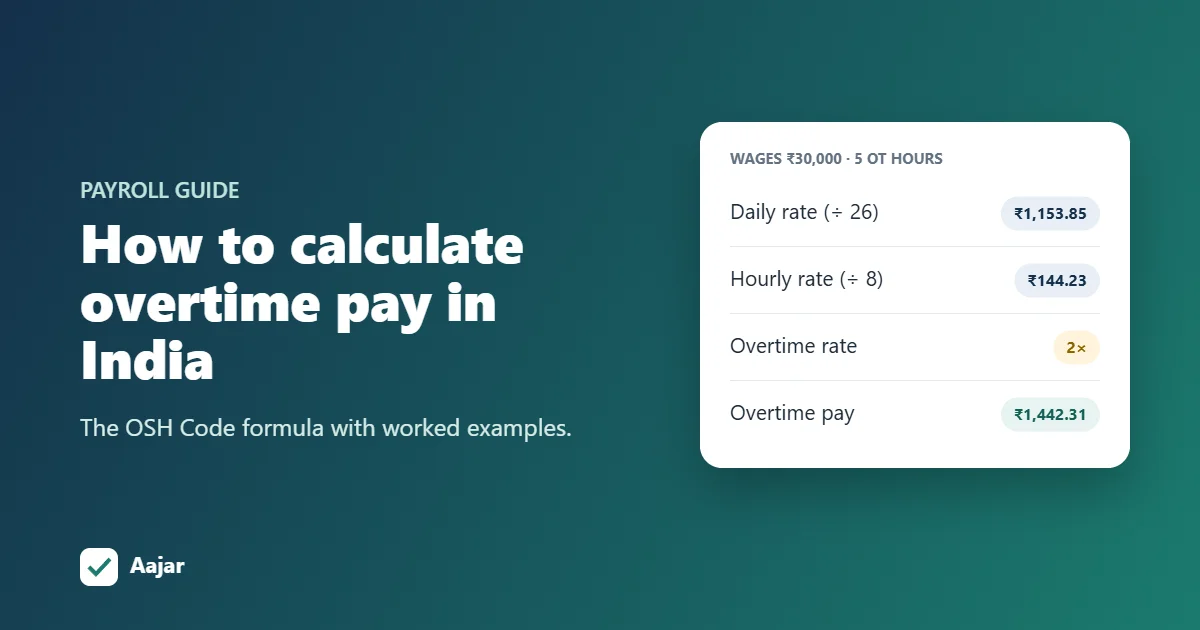
The overtime formula under the OSH Code, 2020: twice the ordinary rate, the 26-day and 8-hour divisors, the 144-hour cap and four worked examples.

Best HRMS Software in India for Small Business (Compared)
Five HRMS platforms for Indian small businesses compared on price, attendance, payroll and free options, with what a 25-person team pays.